The World's Largest Kilt, the Golden Driller, and the Scotfest habit of asking "Why not?"
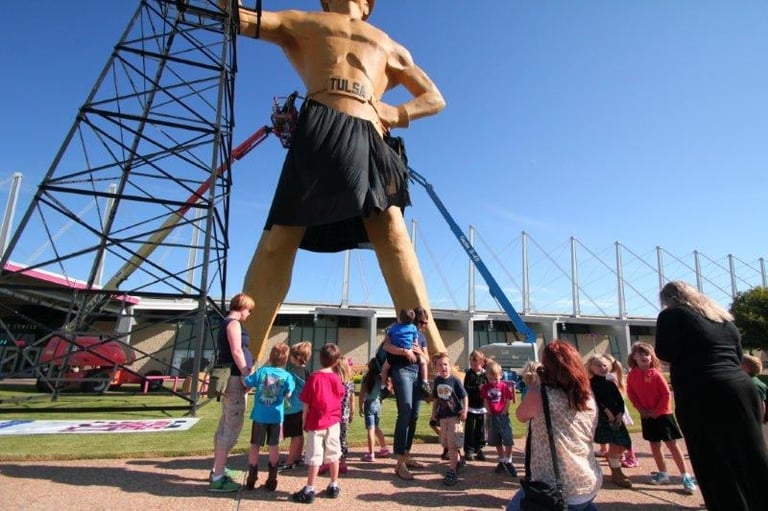
Perhaps nothing captures Scotfest's refusal to accept "that can't be done" better than the time Steve Campbell decided to build the World's Largest Kilt and put it on a 76-foot-tall statue.
Steve Campbell
Chairman & Former Executive Director
Part Three of The Final Chapter — stories, memories and reflections from nearly twenty years behind Scotfest.
By Steve Campbell, Chairman and Former Executive Director
I have always had a slight problem with the phrase:
"That can't be done."
Tell me something can't be done and there is a reasonably good chance my immediate reaction will be:
"Why not?"
This is not always a particularly healthy personality trait.
It has created an enormous amount of additional work over the years.
It has occasionally cost money we probably shouldn't have spent.
It has resulted in me standing in fields, on stages, underneath equipment and, on at least one occasion, dozens of feet in the air wondering how exactly my life had reached this point.
But it has also produced some of my favorite Scotfest memories.
And perhaps nothing captures that mentality better than the time I decided we should build the World's Largest Kilt and put it on the Golden Driller.
Yes.
That one was my idea.
I have nobody else to blame.
It was spring 2011.
The Golden Driller is one of Tulsa's most recognizable landmarks — a 76-foot-tall monument to Oklahoma's oil industry.
Most people look at him and see an enormous oil worker.
I looked at him and thought:
"We should put a kilt on that."
Not a tartan sash.
Not a banner.
A proper kilt.
A ridiculously large one.
And because putting a giant kilt on a 76-foot statue apparently wasn't ambitious enough, I decided we should attempt to make it the largest kilt in the world.
The idea came together around April.
Scotfest was in September.
So naturally we had loads of time.
About five months.
To invent something we had never built before.
Work out the dimensions.
Raise the money.
Create a worldwide tartan competition.
Have custom fabric manufactured.
Sew it.
Pleat it.
Figure out how to lift it dozens of feet into the air.
And somehow wrap it around a concrete oil worker without killing anybody.
Perfectly reasonable.
I didn't want the project to be simply a publicity stunt.
If we were going to put this much time and effort into something, we should try to use the attention to do some good.
So we built a website around the challenge and tied it to fundraising for two organizations supporting wounded service members:
Wounded Warrior Project in the United States and Help for Heroes in the United Kingdom.
Then we turned the choice of tartan into part of the fundraiser.
Clans and supporters around the world could donate and select the tartan they wanted to see used for the World's Largest Kilt.
Whichever tartan raised the most money would win.
It was a wonderfully Scottish way of doing things.
We effectively said:
"Which clan wants bragging rights badly enough to put its money where its tartan is?"
Eventually, the winner emerged:
Black Watch.
Given the military heritage associated with Black Watch and the two veterans' charities we were supporting, it could hardly have been more appropriate.
Now there was just one slight problem.
We actually had to make the thing.
A regular tartan pattern would have looked ridiculous at that scale.
From the ground, the sett would simply disappear.
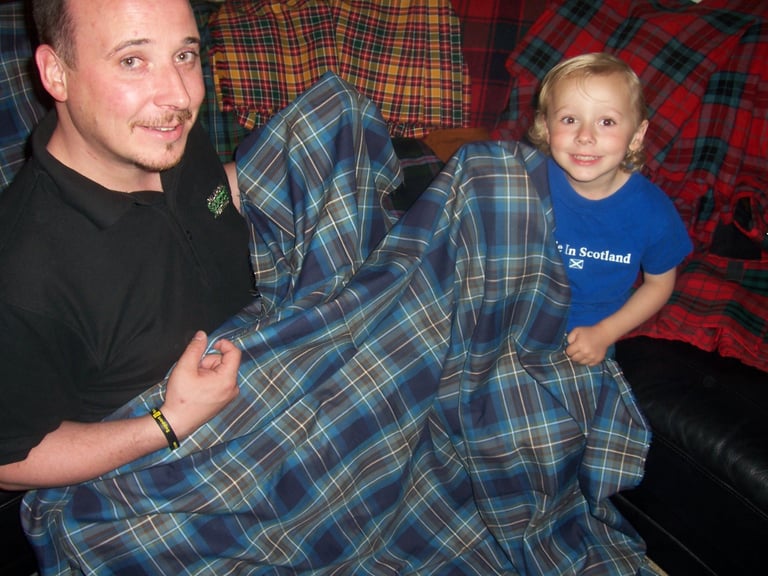
So we had the fabric custom manufactured with the Black Watch tartan scaled as large as we could reasonably make it.
We were dealing with something in the region of 177 yards of fabric.
The finished kilt would have a waist of approximately 48 feet and stand roughly 25 feet high.
Normal tailoring advice was becoming increasingly irrelevant.
At some point you cross a threshold where you're no longer really making clothing.
You're constructing tartan architecture.
This may be my favorite part of the story.
We had a public world-record challenge.
A landmark.
Sponsors.
Charities.
Custom-manufactured fabric.
Media attention.
Clearly what we needed was a sophisticated industrial textile operation.
Instead:
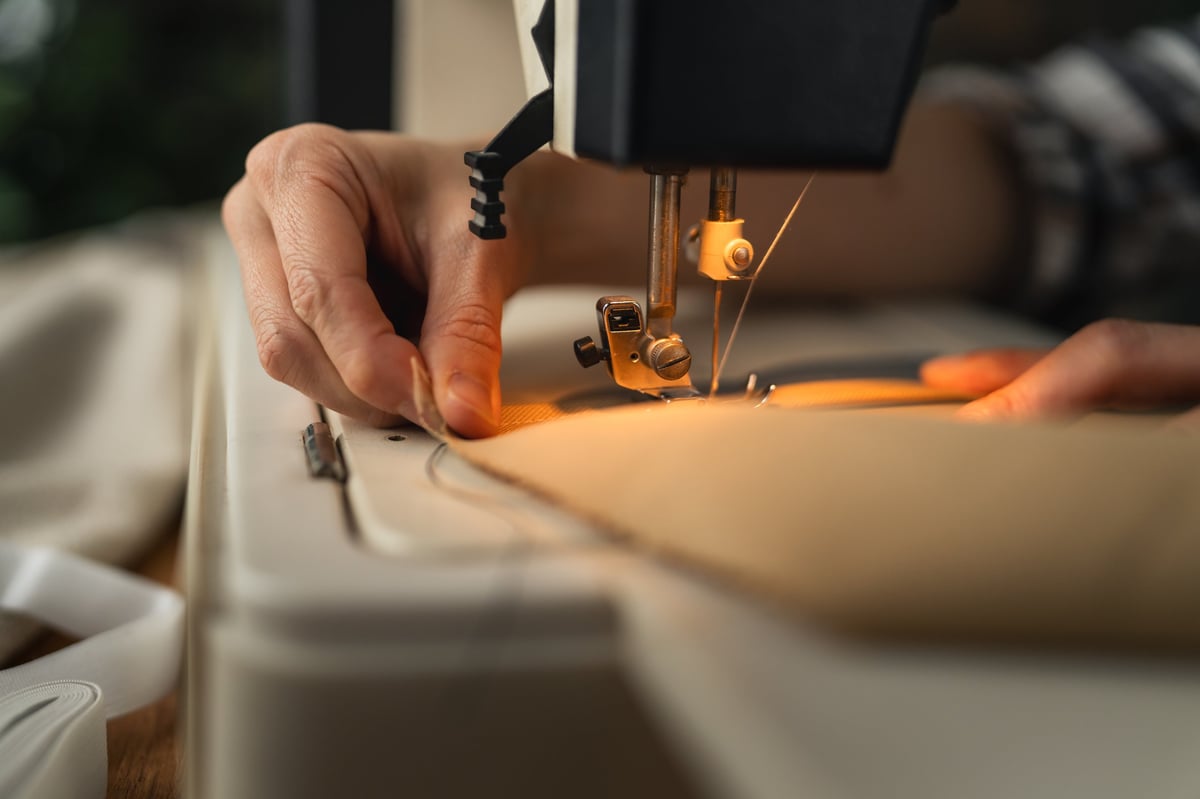
I bought a sewing machine.
And started making the World's Largest Kilt in my house.
Because apparently that was now a perfectly normal thing for me to be doing.
That probably sums up a lot of Scotfest over the years.
People eventually saw the finished spectacle.
What they didn't see was somebody sitting at home thinking:
"Right. I suppose I need to learn how to do this now."
I could figure out much of the construction.
The pleating was another matter entirely.
A proper kilt needs proper pleats.
And when the pleats are twenty-five feet high, mistakes become fairly noticeable.
That's where Judi McLean became invaluable.
Judi helped me work out how we were actually going to construct and stitch the giant pleats across the back.
I absolutely needed the help and remain enormously appreciative that she stepped in.
Without her, the back of the World's Largest Kilt might have looked less like Highland dress and more like an extremely expensive Black Watch duvet cover.
One of the biggest sponsors of the challenge was Belhaven Brewing.
Support like that made projects of this scale possible.
Ideas are cheap.
Fabric isn't.
Neither are lift trucks.
Equipment.
Marketing.
Transport.
Printing.
Insurance.
Or all the other expenses that somehow appear between:
"I've got an idea…"
and
"Dear God, we're actually doing this."
When a sponsor is willing to get behind an unconventional idea, it gives you the ability to push that idea farther than you could alone.
And the World's Largest Kilt was certainly unconventional.
We originally registered the attempt with Guinness World Records and planned the project around documenting the dimensions, construction and installation.
There is, however, one slightly embarrassing detail.
After successfully designing it, fundraising for it, having custom tartan produced, building it in my house, finding sponsors, arranging heavy equipment and somehow getting the Tulsa Fire Department involved…
I never completed the final evidence submission to Guinness.
Apparently even I can procrastinate.
So to be clear: I do not claim this as a Guinness-certified record.
The kilt was, however, subsequently recognized by the World Records Academy, which recorded the achievement as the World's Largest Kilt.
So we got the record.
I just never finished the paperwork with the organization everybody immediately thinks of when they hear the words "world record."
There is probably a lesson in there somewhere about project managers and administrative closeout.
I choose not to explore it.
Eventually, we had a kilt.
A very, very large kilt.
Which presented the next obvious question:
How the hell do you put it on the Golden Driller?
You cannot simply ask him to lift his arms.
He is concrete.
He is 76 feet tall.
And he was remarkably uncooperative throughout the entire fitting process.
So we hired cherry-picker trucks.
The plan was essentially to raise the two sides of the kilt simultaneously, maneuver them around the statue and then bring the front together.
Simple.
At least in the same sense that landing an airplane is simple if you describe it as:
"Point it at the runway and stop."
We got the kilt into the air.
One cherry picker had one side.
Another had the other.
People were holding hundreds of feet of tartan up around the Golden Driller.
And then we discovered a fairly fundamental flaw in our installation plan.
We couldn't get the front around.
We needed more reach.
And more hands.
Preferably attached to something considerably taller than we had available.
There is a very specific moment in event production when a carefully developed plan ceases to be a plan and becomes improvisation.
This was that moment.
So I'm standing up there looking at this enormous Black Watch kilt hanging in midair around a 76-foot statue and thinking:
We need a bigger truck.
Fortunately, I knew a guy.
My neighbor happened to be a Chief with the Tulsa Fire Department.
So while we were still up there trying to hold the kilt in place, I called him.
I cannot remember my exact words.
But the conversation must have been something reasonably close to:
"Any chance you can bring a ladder truck over? We're trying to put a giant kilt on the Golden Driller."
I'm fairly certain that scenario is not included in standard Fire Chief training.
But he came.
And he brought the cavalry.
Tulsa Fire Department arrived with a large ladder truck.
Now we had the reach.
We had the additional manpower.
And between the two cherry pickers, the ladder truck and a group of people who had become far too committed to quit at this stage, we finally managed to bring the front of the kilt around the Driller and get everything into position.
There is something wonderfully Oklahoma about that entire story.
A Scotsman decides to make the world's largest kilt.
Starts sewing it in his house.
Gets it dozens of feet into the air.
Discovers he hasn't got enough people.
Calls his firefighter neighbor.
And the Tulsa Fire Department arrives with a ladder truck to help dress a giant oil worker.
Try putting that in a project-management textbook.
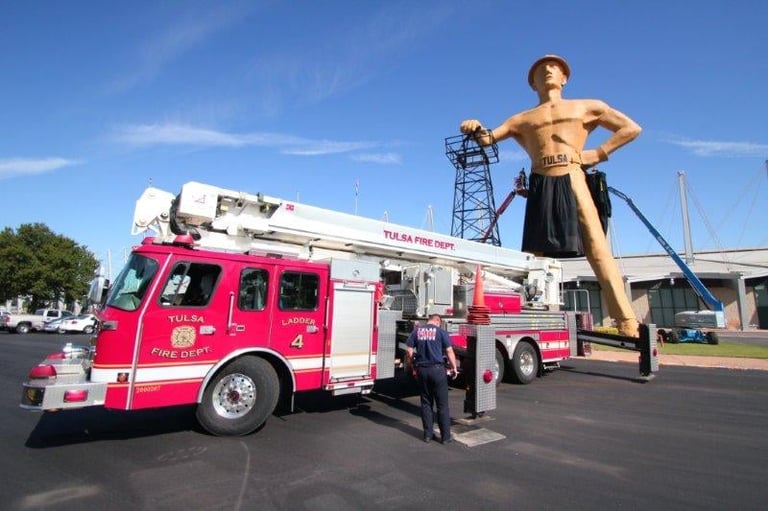
Watch the construction and installation compilation — from sewing machine to cherry pickers to the ladder truck that saved the day.
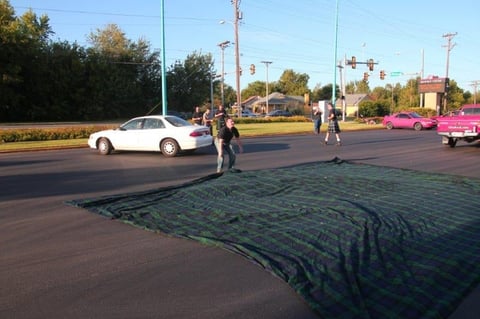
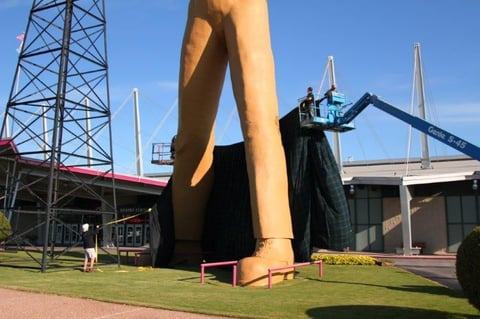
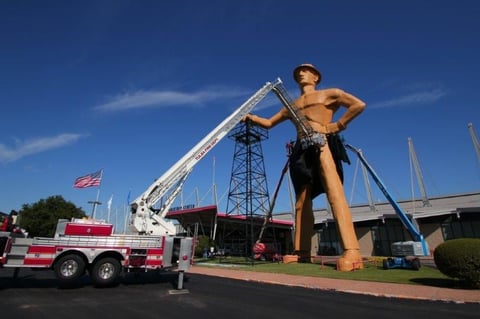
Eventually everything was in position.
The kilt was wrapped.
Cinched.
Adjusted.
And there it was.
The Golden Driller.
Wearing Black Watch.
A 48-foot waist.
Approximately 25 feet high.
Around 177 yards of custom tartan.
Months of work.
A sewing machine in my house.
Judi's enormous pleats.
Belhaven Brewing.
Donations from clans and supporters around the world.
Two veterans' charities.
Cherry-picker trucks.
And one Tulsa Fire Department ladder truck that had definitely not been part of the original project plan.
We had actually done it.
That moment is difficult to describe.
For months, the World's Largest Kilt had existed as an idea.
Then measurements.
Fabric.
A website.
Fundraising.
Emails.
Sewing.
Problems.
Lists.
And suddenly you could step back, look up at one of Tulsa's most recognizable landmarks and see the ridiculous idea that had existed in your head five months earlier.
That feeling never gets old.
We did this.
It's a fair question.
Why would an organization already stretched for money, people and time decide it should also dress a 76-foot statue in a 25-foot-high kilt?
Because festivals need moments.
People rarely remember operational competence.
Nobody leaves Scotfest saying:
"You know, their temporary electrical distribution was outstanding this year."
Hopefully.
What people remember are moments.
The first time they hear massed pipes.
Watching somebody throw a caber.
Discovering their clan.
A great concert.
A photograph with somebody they admire.
Taking their children to see something they have never seen before.
Or driving through Tulsa and seeing the Golden Driller wearing an enormous Black Watch kilt.
Those become stories.
Stories become memories.
And memories are one of the things festivals are ultimately selling.
There was another reason the project mattered to me.
Four years earlier, Scotfest had almost ceased to exist.
In 2007, the festival was carrying roughly $25,000 in debt against an annual budget of only around $40,000 and came very close to cancellation.
We had inherited virtually no operational systems.
Four years later, we were mounting a world-record-scale project on one of Tulsa's most recognizable landmarks.
That transition mattered.
We still didn't have unlimited money.
Far from it.
We certainly didn't have unlimited staff.
What we had developed was something potentially more important:
Confidence that we could figure things out.
That attitude had already carried us through financial problems.
Through the remnants of Hurricane Ike.
Through growth.
And it would later carry us through venue moves, dramatically larger events, COVID and plenty of other situations where the easiest answer would have been:
"We can't."
There is an important distinction here.
Good event management is not recklessness.
You absolutely have to consider:
Safety.
Budget.
Insurance.
Engineering.
Logistics.
Permits.
Resources.
Time.
And consequences.
The difference is whether those things become reasons to stop thinking or questions that need answering.
Instead of:
"We can't do that."
I generally prefer:
"What would it take to do that?"
How much will it cost?
Who knows how?
Who can help?
Can someone donate something?
Can we borrow it?
Can we build it?
What equipment is required?
What could go wrong?
How do we mitigate that?
Who knows somebody?
And occasionally:
Does anyone have access to a large Fire Department ladder truck?
That's how ideas become projects.
As Scotfest grew, the scale of what we were willing to attempt grew with it.
When I became involved, attendance was only a few thousand.
By 2022, more than 30,000 people attended.
The entertainment grew.
The Highland Games grew.
The cultural programming expanded.
The whisky program grew.
The vendors increased.
The production became more sophisticated.
We started attracting opportunities and personalities that would have seemed wildly unrealistic in those early years.
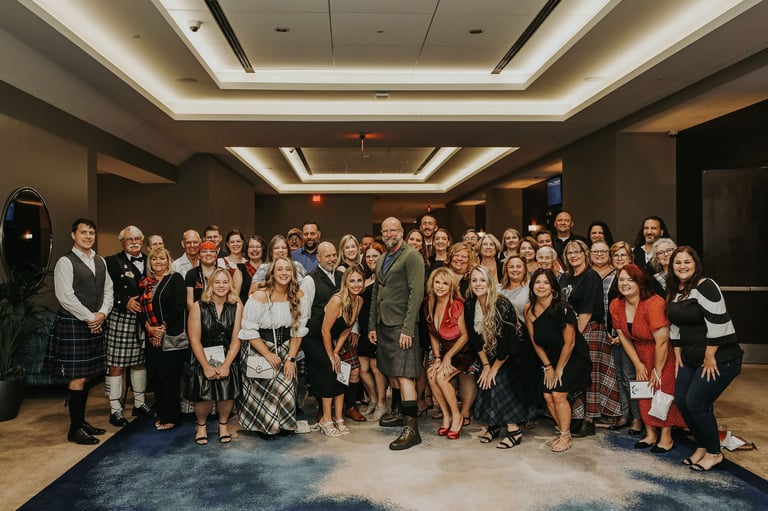
One of our biggest celebrity guests was Graham McTavish.
And despite his profile, Graham turned out to be exactly what you hope somebody like that will be:
An absolute gentleman.
Professional.
Easy to work with.
And generous with the people around him.
Those milestones matter because every successful leap makes the next one feel slightly more attainable.
Once you've successfully put a 25-foot kilt on a 76-foot statue with assistance from the Fire Department, a lot of future conversations start with:
"Well, compared with the Driller…"
History also has a tendency to make successful people look far more intelligent than they actually were.
So for the record:
Not every Scotfest idea worked.
Some were excellent.
Some were average.
Some sounded brilliant in a meeting and turned out to be terrible in reality.
Some cost too much.
Some consumed enormous amounts of time for very little return.
Some we tried once and quietly decided never to mention again.
That is part of innovation too.
You experiment.
You learn.
You adjust.
You occasionally waste money.
You occasionally waste time.
And every so often you stand in a field staring at something you personally approved six months earlier thinking:
"Well, that was bloody stupid."
Then you learn from it and move on.
There is something else the World's Largest Kilt taught me.
I had the idea.
But the idea was the easy bit.
Ideas take seconds.
Execution takes people.
The people who donated.
The clans who competed.
The charities.
The sponsors.
Belhaven.
Judi helping solve the pleating problem.
The people who worked on the construction.
The people running the lifts.
My neighbor answering a very strange telephone call.
Tulsa firefighters showing up when we discovered that our carefully considered installation plan was exactly one ladder truck short.
Those are the people who turn:
"Wouldn't it be cool if…"
into:
"Look what we did."
And when I look back across nearly twenty years, I increasingly believe that is the real story of Scotfest.
There are a lot of moments in Scotfest history where I can now look backward and think:
We probably shouldn't have been able to pull that off.
The World's Largest Kilt is certainly one of them.
We went from an idea in April to a 48-foot-waist, 25-foot-high Black Watch kilt hanging on the Golden Driller in September.
We created a global tartan fundraiser.
Supported two veterans' charities.
Attracted major sponsorship.
Custom-ordered the fabric.
Built much of the thing in my house.
Worked out how to create giant pleats.
Hired cherry pickers.
Ran out of hands.
Called the Fire Department.
And somehow ended with almost exactly the photograph I had imagined months earlier.
That is Scotfest.
Not unlimited money.
Not unlimited resources.
Certainly not unlimited common sense.
Just people willing to say:
"We'll figure it out."
And then figuring it out.
Sometimes with volunteers.
Sometimes with sponsors.
Sometimes with a sewing machine.
Sometimes with heavy equipment.
And sometimes with the Tulsa Fire Department.
For nearly twenty years, I became very good at saying:
"Yes. We'll figure it out."
What I wasn't always as good at was asking another question:
What is all this figuring-it-out costing the people doing it?
Because ambitious ideas consume more than money.
They consume evenings.
Weekends.
Energy.
Sleep.
Family time.
Relationships.
And eventually, if you keep saying yes to something long enough, something else in your life inevitably receives less of you.
That is a much harder story to tell than putting a giant kilt on a statue.
But if I'm going to tell the story of Scotfest honestly, I can't only tell you about the things we accomplished.
I also have to tell you what some of those accomplishments cost.
That's next.
Steve's stories from nearly twenty years behind Scotfest — the victories, the ridiculous ideas, and the costs nobody saw.
How one volunteer accidentally ended up running the place — the unglamorous, irreplaceable labor behind forty-six years of community.
READ PART ONE →Hurricane Ike, the picnic table pit crew, a festival that became a temporary city — and all the infrastructure nobody was meant to see.
READ PART TWO →Ambitious ideas consume more than money — evenings, weekends, energy, sleep, family time, relationships. The honest face of nearly twenty years of saying "yes."
READ PART FOUR →Want to be part of the story one last time?