
What it really takes to build Scotfest.
From the public side of the fence, Scotfest is supposed to look fairly simple. That's the bit you're meant to see. What you're not supposed to see is everything holding it together.
Steve Campbell
Chairman & Former Executive Director
Part Two of The Final Chapter — stories, memories and reflections from nearly twenty years behind Scotfest.
By Steve Campbell, Chairman and Former Executive Director
There is an important rule about kilts.
You probably shouldn't ask what's underneath unless you're genuinely prepared for the answer.
Festivals work much the same way.
From the public side of the fence, Scotfest is supposed to look fairly simple.
You arrive.
There are bands playing.
Pipers piping.
Dancers dancing.
Highland athletes throwing things that normal people would generally consider far too heavy to throw.
There are clans, vendors, food, whisky, beer, Highland cows and thousands of people wandering around having what we sincerely hope is a very good weekend.
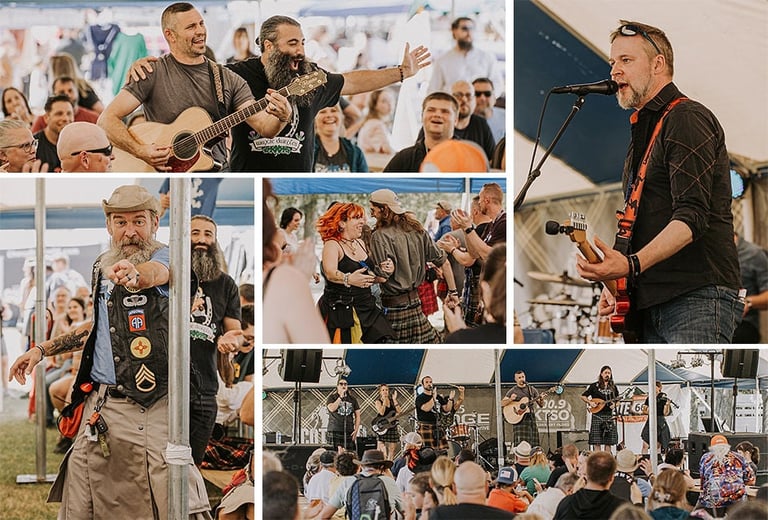
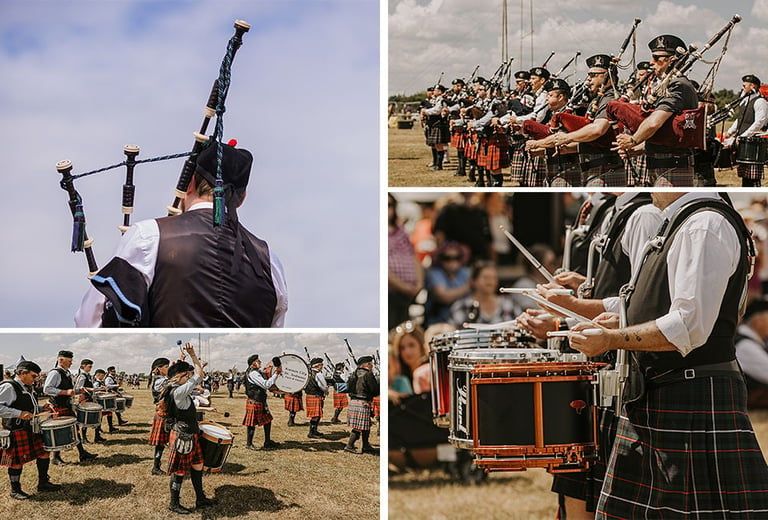

That's the bit you're meant to see.
What you're not supposed to see is everything holding it together.
The cables.
The toilets.
The rubbish.
The site plans.
The budgets.
The trucks.
The broken tables.
The weather radar.
The radios.
The arguments.
The things held together temporarily because somebody has promised they'll fix them properly after the festival.
The problems that appeared twenty minutes ago and absolutely have to be solved before anyone realizes there was a problem in the first place.
That's what's underneath the kilt.
And after almost twenty years, I've seen rather more of it than I probably needed to.
Spreadsheets, budgets, cables, toilets, rubbish bags. And mostly — people.
I became Executive Director after the 2007 festival.
So naturally, for my first full Scotfest in charge in 2008, the remnants of Hurricane Ike decided to come through Oklahoma.
There are probably easier ways to learn event management.
Saturday evening, the weather was deteriorating and we had a decision to make.
Do we shut the festival down?
Eric was adamant that we should.
The previous year he had witnessed the weather disaster at Tulsa Oktoberfest, so he understood exactly what could happen when severe weather hit an outdoor event.
Our Entertainment Director, David, understandably had another perspective.
We had bands onsite.
They wanted to perform.
We were paying them regardless.
There were people already at the festival.
And shutting an event early is not a trivial decision.
Meanwhile, the park authority seemed understandably reluctant to make the decision for us.
Which meant eventually the decision belonged to me.
Eric and I got into an enormous argument.
At one point I walked away while he was talking to me.
He understandably thought I was simply walking away from the argument.
I wasn't.
I needed to get away from everybody for a moment, gather my thoughts and work through the consequences.
Because when you're responsible for an event, decisions like that are not theoretical.
If I closed too early and nothing happened, we'd lose revenue, disappoint guests, disrupt performers and potentially damage an event that was already financially vulnerable.
If I kept it open and the weather became dangerous, the consequences could be considerably worse.
About an hour later, I made the call.
Shut it down. Send everybody home.
About an hour after that, the storm hit hard.
The following morning, the festival grounds looked like a war zone.
Tents had been damaged.
Things had moved that had not been intended to move.
The site needed substantial cleanup.
And we had approximately an hour to get enough of it back together to reopen.
So that's what everybody did.
Eric came back in.
We started cleaning.
Moving.
Repairing.
Fixing.
Getting the place ready.
At some point, once we could finally see that the festival was going to reopen, one of us essentially said to the other:
"Let's get a beer. Are we good?"
"Of course."
And that was it.
Eric and I have been best friends ever since.
There are actually two lessons in that story.
One is about event management.
Sometimes there is no perfect answer.
There is simply a decision that somebody ultimately has to make.
The other is about the people you work with.
When you're exhausted, under pressure and responsible for something important, you will occasionally disagree.
Sometimes loudly.
What matters is whether everyone remembers that you're ultimately fighting for the same thing.
In 2008, Hurricane Ike taught me both lessons rather efficiently.
A guest sees a tent.
An event organizer sees a project.
How big is it?
Where does it go?
When is it arriving?
Can the truck reach the location?
Can we stake it into the ground?
If not, how much ballast does it need?
Where does the power come from?
Does it need lighting?
What happens if the wind picks up?
Who's using it?
Do they need tables?
Chairs?
Internet?
Water?
And why is someone asking me where the tablecloths are while I'm trying to work out whether the electrical distribution can handle another food vendor?
That is one of the strange side effects of running festivals for twenty years.
I don't think I can attend an event normally anymore.
Other people walk into a festival and see entertainment.
I see infrastructure.
I look at their fencing.
Their toilets.
Their generators.
Their signage.
Their vendor layout.
Their parking.
Their rubbish collection.
I look at where they've positioned the food vendors and wonder why.
I see a line at a beer tent and mentally start redesigning the service operation.
Somebody beside me will say:
"This is great, isn't it?"
Yes.
Probably.
I'm just wondering where they've hidden their dumpsters.
The scale changed dramatically over the years.
When I first became involved in 2007, Scotfest attracted a few thousand people.
By 2022, more than 30,000 people were attending.
And as attendance grows, almost nothing simply gets bigger.
It gets more complicated.
More attendees means more parking.
More toilets.
More rubbish.
More food.
More beer.
More security.
More medical planning.
More fencing.
More volunteers.
More ticketing capacity.
More power.
More water.
More traffic.
More questions.
More opportunities for something to go wrong.
For a few days every year, Scotfest effectively became a small temporary town.
The difference was that most towns don't have to be assembled on Wednesday and largely disappear again by Monday.
Someone has to create all of it.
Then dismantle it.
And the vast majority of people experiencing it will never know how much work happened before they arrived.
That's success.
There may be an impression that being the Executive Director or Chairman of a major festival involves important meetings, sponsor lunches, photographs, speeches and perhaps drinking good whisky with interesting people.
There has certainly been some of that.
There has also been toilet maintenance.
I've placed them.
Stocked them.
Cleaned them.
Fixed them.
I've picked up rubbish all weekend and after the public went home.
I've moved equipment.
Loaded vehicles.
Unloaded vehicles.
Moved tables.
Crawled around underneath things.
Gone directly from meeting sponsors or dignitaries to solving whatever unpleasant problem had just become urgent.
There have been festival days when we've been onsite before 6 a.m., left around 3 a.m., and returned at 6 a.m. to start again.
Three hours of sleep begins to feel luxurious.
Eventually everyone reaches a point during festival weekend where titles become fairly meaningless.
If a bin needs emptying, empty it.
If something needs moving, move it.
If a toilet needs attention…
Well.
Leadership has its limits.
But yes, I've done that too.
The equipment operation Scotfest inherited in the early years was not exactly sophisticated.
One of our storage solutions involved what was essentially an old U-Haul box truck body being used as a trailer.
It contained an impressive collection of old equipment, miscellaneous junk and things whose purpose had perhaps once been understood by someone but had since been lost to history.
The trailer itself was, to put this diplomatically:
Extremely unsafe.
Roadworthy would also have been an ambitious description.
But when you're running an event with virtually no money, you don't immediately replace everything that's terrible.
First you work out what will kill someone.
Then what might kill someone.
Then what is merely inconvenient, ugly or held together by optimism.
Over the next few years, as we were able to find alternatives, we got rid of it and cleared out years of accumulated junk.
That gradual transformation happened across Scotfest.
We didn't wake up one morning with a professional festival operation.
We built one.
Piece by piece.
Year by year.
Usually when we could finally afford it.
Moving venues creates problems the public rarely sees.
When Scotfest moved away from River West Festival Park, one of the things we lost access to was something wonderfully mundane:
Picnic tables.
Nobody buys a festival ticket because the event has outstanding picnic tables.
But wait until you have thousands of people trying to eat without anywhere to sit.
Suddenly picnic tables become rather important.
So on a limited budget we bought materials and built replacements ourselves.
Over time, as resources allowed, we upgraded to considerably better galvanized steel-framed tables with pressure-treated eight-foot tops and seats.
But what I remember most fondly was the attitude toward maintaining them.
If somebody spotted a damaged or unsafe table during the event, people descended upon it like a Formula One pit crew.
Tools appeared.
People appeared.
Whatever had worked loose or broken got repaired.
The table went back into service.
Why?
Because somebody could get hurt.
And because once you're personally invested in building an event, you start treating things differently.
It's not:
"Someone should fix that."
It's:
"Let's fix that."
That attitude is perhaps one of the things about Scotfest I will miss most.
People often compliment an event by saying:
"Everything ran smoothly."
There may be no greater compliment you can give an event organizer.
Because "everything ran smoothly" almost never means nothing went wrong.
Things always go wrong.
Equipment breaks.
People get lost.
Deliveries arrive late.
Something trips an electrical breaker.
A vendor needs something they were supposed to bring themselves.
Weather changes.
A vehicle gets stuck.
Someone doesn't show up.
A performer needs something.
The internet stops cooperating precisely when thousands of people want to buy something.
The difference between a good event and a bad one often isn't the number of problems.
It's how many the public notices.
If ten things go wrong behind the scenes and ten people quietly fix them before they affect the guest experience, the public sees a successful festival.
Perfect. That's exactly what we want.
Large public events also reveal an interesting truth about human beings.
Signs become invisible.
You can install a very large sign.
Use enormous letters.
Add an arrow.
Make it brightly colored.
Place it directly in somebody's line of sight.
They will stand beside it and ask a volunteer:
"Where is the beer?"
At some point you simply accept this.
It is a law of nature.
Like gravity.
Or Oklahoma weather.
Every festival volunteer eventually develops the ability to answer the same question for the 147th time as enthusiastically as they answered it the first time.
The truly great volunteers can even do it without visibly dying inside.
Another dangerous phrase in event management is:
"Wouldn't it be cool if…"
Many of the best things Scotfest ever did began with that sentence.
Unfortunately, so did many of the things that caused me weeks of additional work.
Ideas are wonderful.
I love ideas.
The problem is that ideas rarely arrive carrying their own budget, volunteers, insurance, power requirements, equipment, permits or detailed implementation plan.
Someone says:
"Wouldn't it be cool if we did this?"
Yes.
It would.
Who's doing it?
Silence.
Who's paying for it?
Silence.
How does it work?
More silence.
At which point, somehow, it appears on my list.
Over the years some of those ridiculous ideas became some of our greatest successes.
One of them involved dressing a 76-foot-tall Oklahoma landmark in a kilt.
But that deserves its own story.
The bigger Scotfest became, the more financial risk sat beneath everything the public saw.
By 2022, producing the event cost more than $600,000.
That means before the first pint is poured, the first caber is thrown or the first band takes the stage, enormous financial commitments have already been made.
And unlike many businesses, festivals have an uncomfortable relationship with weather.
You can spend hundreds of thousands of dollars preparing the product.
Then a storm can decide whether people buy it.
That's stressful.
And one of the things outsiders often don't realize is that a festival can look extraordinarily successful to the public while the people running it are still worrying about whether all of the bills will be covered.
After COVID, many operating costs increased substantially. Insurance alone rose by more than 500 percent.
The public sees a three-day festival.
Leadership sees twelve months of financial exposure.
I never really resented that.
I chose it.
But I certainly felt the weight of it.
Almost every year.
People also understandably develop emotional attachments to festival locations.
When Scotfest moved from Tulsa to Broken Arrow in 2018, some people were unhappy.
Some still are.
The comparison frequently made was:
"Oktoberfest manages to stay there."
True.
But the two events have fundamentally different footprints.
A major Oktoberfest is primarily tents, food, beer and entertainment.
Scotfest needs all of those things plus an athletic field, Highland Games infrastructure, clan areas, cultural programming, competitions and other activities that require considerably more physical space.
We had simply outgrown the old location.
Moving wasn't easy.
Moving a festival never is.
Every location has power quirks.
Traffic issues.
Parking challenges.
Infrastructure limitations.
Things that worked brilliantly at the previous venue and are suddenly useless at the new one.
Even picnic tables.
But Broken Arrow's support also demonstrated how important municipal partnerships can be.
The City provided significant cash support, city services and marketing assistance — resources that directly affected our ability to build and grow the event.
Those aren't particularly sexy festival stories.
Nobody photographs the municipal services agreement.
But that's part of what's underneath the kilt too.
People sometimes describe event management as organized chaos.
That's reasonably accurate.
Although occasionally the word "organized" is doing a lot of work.
The real skill isn't creating a world in which nothing goes wrong.
That world does not exist.
The skill is planning enough that when something inevitably does go wrong, you've left yourself enough people, equipment, knowledge, relationships and flexibility to deal with it.
Hurricane Ike taught me that in my first official year.
Every Scotfest afterward reinforced it.
Plan.
Prepare.
Communicate.
Build.
Fix.
Adapt.
And when all else fails, find Eric.
Apparently he'll even come out at three in the morning when you've blown out two tires.
So after all these years, what has actually been underneath Scotfest?
A lot of things.
Spreadsheets.
Budgets.
Contracts.
Insurance.
Municipal relationships.
Generators.
Power cables.
Rubbish bags.
Toilet paper.
Trucks.
Tools.
Tables.
Radios.
Weather radar.
And undoubtedly several things repaired with more enthusiasm than engineering.
But mostly?
People.
People willing to turn up before sunrise.
People willing to stay after everyone else has left.
People willing to fix the table instead of walking past it.
People willing to argue passionately about what they believe is the right decision and then share a beer afterward.
People willing to do jobs nobody will ever applaud.
People willing to make something work because thousands of strangers are depending on them to make it work.
That's what's underneath the kilt.
The public sees the festival.
Behind the curtain, we see the thousands of decisions, arguments, repairs, compromises, relationships and occasional miracles required to make the festival appear.
And if we've done our jobs properly?
You never notice any of it.
Which is precisely the point.
Of course, some of the things we attempted over the years were considerably harder to hide.
Like putting a 48-foot-waist, 25-foot-high kilt on the Golden Driller.
But we'll get to that.